
VAASTU: SEEN FROM THE LENS OF ‘RESONANCE’
A- Introducing ‘Aayadi Vaastu’ at three recent masterclasses to diverse design audience:
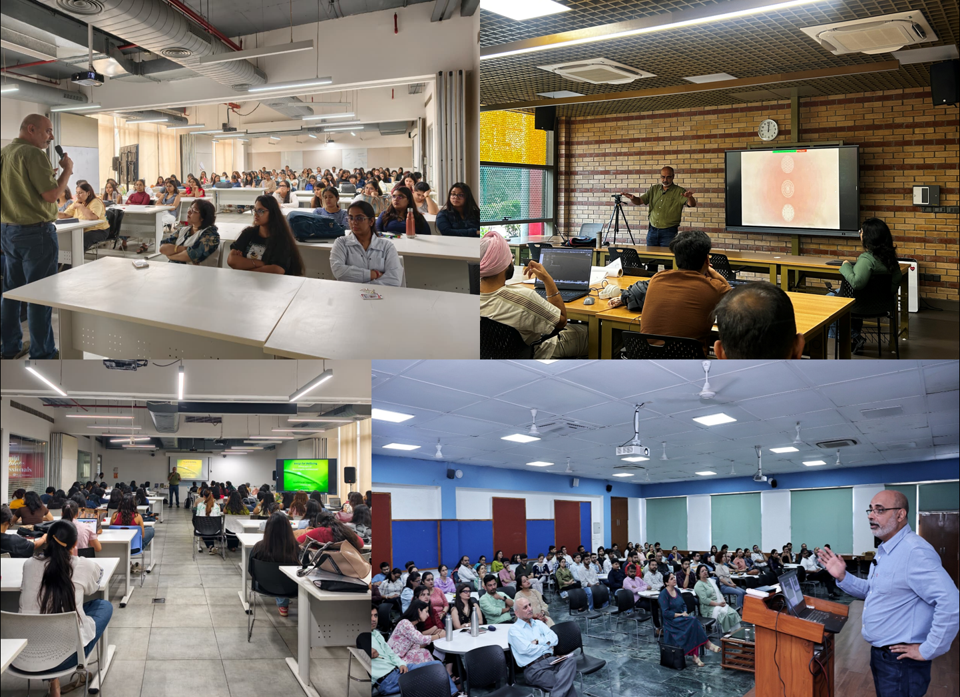
Over the past two months, I had the privilege of speaking on Bioenergetic Architecture and specifically about the precept of Aayadi Vaastu at three very different platforms — a faculty development program at a private university, a guest masterclass at a design school, and a department-level session for interior design students - Three audiences with three very different contexts.

What stood out across all three forums was a common question, asked in different words each time: "Isn't Vaastu mainly about which room faces which direction?"
That question is exactly why I keep returning to one specific idea whenever I talk on this subject — RESONANCE.
Aayadi Vaastu, at its core is not just a rulebook of do's and don'ts. It is a mathematics of resonance.
Of course before proceeding to explain this subject I set the ground by explaining what is ‘Biofield’ and how human beings are exceptionally sophisticated ‘energy systems’ and subsequently leading to the idea that we all have our ‘unique invisible, energetic finger-print’ (commonly understood as core tendencies or nature or personality traits). Our biofield is the sum total of the pattern of ‘life energy of prana’ that flows through us gracing us with unique attributes at physical and mental levels.

The word "Aayadi" (Read ‘Aaya + aadi’ in hindi and you will get underlying meaning this word implies) comes from a set of six classical formulae — Aaya, Vyaya, Yoni, Nakshatra, Vara and Tithi — applied to arrive at a building's perimeter and proportions. What these formulae are actually doing is calibrating a structure's dimensions so that its ‘vibrational signature’ sits in harmony (resonance) with the ‘vibrational signature’ people who will occupy it — much the way a stringed instrument is tuned to a particular note before it is played.
In each masterclass, once this definition of vaastu lands — that a building's outer wall behaves less like a static boundary and more like a resonating body — the conversation shifted. Students stopped asking "which direction should my door face" and started asking : how does proportion affect experience? How does a space's geometry interact with its occupants over years? Can design itself be a quiet, continuous intervention for wellbeing rather than a one-time aesthetic decision?
That, to me, is the real value of sharing this subject — not persuasion, just widening the perspective!
B- The uncomfortable truth about contemporary Vaastu practice and it’s perception:
Too often Vaastu is communicated (read: marketed) on a platter of ‘fear and greed’ — ‘this door will ruin your fortune’ or ‘that corner is missing and will bring disease’ and so on. This does not seem like sharing ancient wisdom but more like commercial exploitation wearing ancient clothing.
It approach has done real damage to homeowners/ developers who make expensive, anxiety-driven changes without understanding ‘why’. It has also damaged the credibility of a genuinely rigorous discipline among architects and engineers who (rightly) dismiss the fear-mongering version outright.
It is saddening that this discipline is not in the mainstream of architecture colleges because it’s underlying codified principles have either never been properly understood and applied or these been distorted for commercial ends only.
Perhaps it’s time to evolve!
The version of Vaastu I prefer to discuss in my masterclass and the version I apply in my practice — has no room for either fear or greed. It only asks few straight questions:
1. Can we mathematically and thoughtfully align a space with the people who will live and work in it at the level of proportion, geometry and resonance — as one respectful, evidence-informed layer among many in the design process?
2. Can we align our spaces with the geomagnetic envelop we live in?
3. Can we mitigate the impact of excessive electromagnetic radiations and geopathic stresses that surround us (without us even being aware of these?)
4. Can we design architecture that enhances, expands and reinforces our biofield by just ‘being’ in a particular space?
....and more!
No guarantees. No fear tactics. Just a deliberate design discipline applied with the same rigor we would apply to architecture, structural engineering or sustainability consulting.
C- From the Classroom to the Site: Applying Resonance at Scale
Vaastu was codified in a world without attached toilets, embedded wiring, or an atmosphere saturated with electromagnetic radiation. Applying it faithfully today means understanding the why behind each dictate — not just the letter — and then translating it for how we actually live and build now. Blind imitation of a text is a poor substitute for genuine understanding.
Let me walk through what application of Aayadi Vaastu actually looks like in practice — using a recent large-scale assignment: designing some high-end campus spanning multiple blocks across Hyderabad and Mumbai, for a client whose brief demanded both scientific rigor in the labs and genuine wellbeing for the teams working within them.

Here are the few insights that became centric to our advisory role to the architectural design team. All these were systematically calculated, mapped and then shared via presentations and video calls and design reviews so that architects evolved the concept on these guidelines:
1. Resonance begins before the first wall is drawn.Before any building footprint was finalized, the organisation's own "Naam Nakshatra" (derived from its name and inception details) and the phonetic signature of the location were used to mathematically arrive at the building's perimeter — in this case, a very specific dimension that then became the seed for every subsequent grid. This is the opposite of applying Vaastu as an afterthought or a compliance checklist at the end of design. It has to be the first input.

2. The entire site is treated as one living mandala — not just the building.Before a single block was placed, the full plot was overlaid with an 81-segment energy grid to identify preferred zones for entries, utilities, water bodies, service blocks and — critically — nine sensitive "Marma" points where no structural load, column or core should ever sit. This site-level thinking upstream saves enormous rework downstream.
3. Cardinal orientation is the one non-negotiable.A building aligned to true north-south-east-west (with a small, specific tolerance known as Eshaa-prachi) sets up everything that follows — energetically and even climatically. This was the very first check applied to the campus masterplan, well before any block footprint was drawn.
4. Circulation direction is a design decision, not an afterthought.Recommending clockwise vehicular movement across the campus — mirroring what classical texts call the "Pradakshina" or creation-energy cycle — is a subtle but deliberate choice that, once you notice it, you start seeing (or its absence) in every masterplan you evaluate afterward.

5. Where you enter matters more than how grand the entrance looks.Contrary to popular belief, an entry is permitted from any of the four sides of a plot — but where exactly on that side matters immensely, since the threshold is where the inner and outer worlds meet, physically and psychologically. On this project, gate positions were deliberately mapped against the site's energy grid rather than decided by road access alone.
6. Time has its own rhythm too.Even the timing of breaking ground is treated as a design variable — a "muhurta" or auspicious moment aligned to a favourable rhythm, not unlike choosing the right conditions to set sail! It's a reminder that Vaastu was always meant to be a living, contextual practice — not a rigid inheritance to be applied without thought.
There were many more finer considerations while planning and still more that will be carried out during construction stage to mitigate adverse impacts of site and surroundings and harmonize subtle energy realm. These are methodically planned and measured ‘before and after’ installation…. but more of that in another post!
D- Keen for more?
If you're an educator, a homemaker, a developer or a practicing architect, curious about where subtle-energy science and Aayadi Vaastu genuinely meet contemporary design practice— welcome to dive deep in the book ‘Architecture for wellbeing’ ( check out on website www.bioenergetic-architecture.com) or let’s team up on your next project.
If you are an institution or a corporate exploring a masterclass for Holistic Wellbeing of your team or enhancing productivity at work or harmonizing energy in the space you occupy – feel free to reach out!


Comments